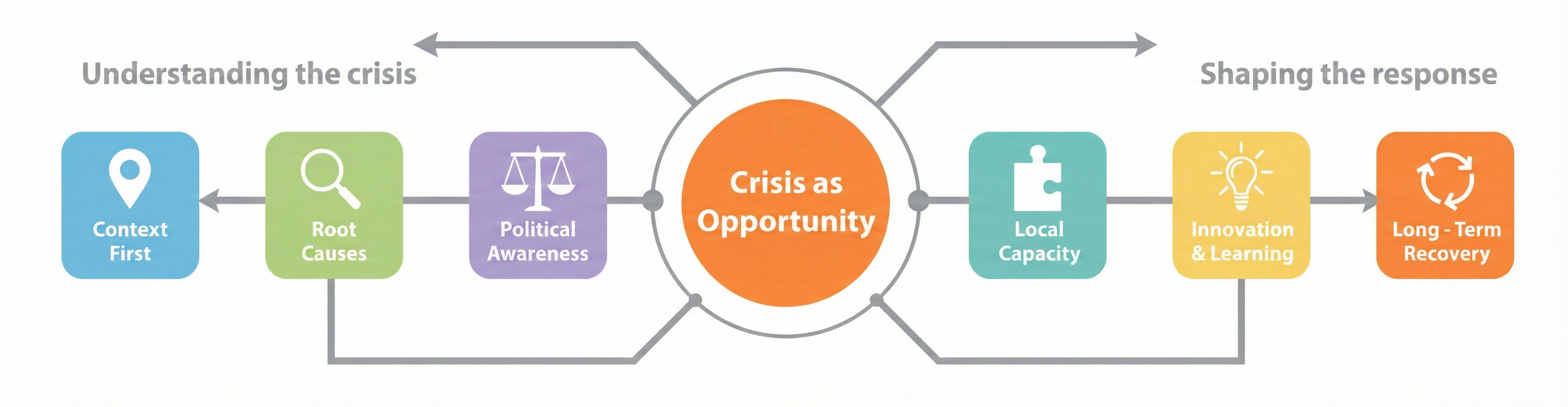
While Cuny himself never summarized his approach into a framework, when you look back across his work his core principles can be written as follows.
Context First
Aid must be carefully adapted to the local political, economic, and cultural environment, because generic, one-size-fits-all models often fail to achieve meaningful, sustainable results.
Root Causes
Humanitarian efforts must tackle the underlying vulnerabilities and structural issues that perpetuate crises, moving beyond immediate relief to prevent recurrent disasters and create lasting stability.
Political Awareness
Practitioners must remain acutely aware of what political factors might have led to or exacerbated the crisis, as well as, how aid can be used for political gain or manipulation in order to responsibly navigate these sensitive dynamics and ensure resources reach those most in need.
Local Capacity
Effective assistance must leverage existing local resources, knowledge, and low-cost solutions, as this approach is essential for building long-term resilience and reducing dependency on external actors.
Innovation & Learning
To ensure accountable aid, practitioners should be flexible, test new ideas, and continuously evaluate what works, allowing them to adapt their strategy as conditions evolve.
Long-Term Recovery
Post-disaster reconstruction is a crucial opportunity to promote development, reform local institutions, and enhance long-term resilience, rather than simply rebuilding the same vulnerabilities.
Cuny's practical insights informed lasting changes throughout the humanitarian assistance and disaster response fields. In the case of refugee camp design, he and his colleague, Paul Thompson, played an instrumental role in designing standards that emphasize protection, dignity, and social cohesion which have become cornerstones of modern camp management. Through both fieldwork and widely read monographs, Cuny influenced generations of humanitarian practitioners and policymakers.